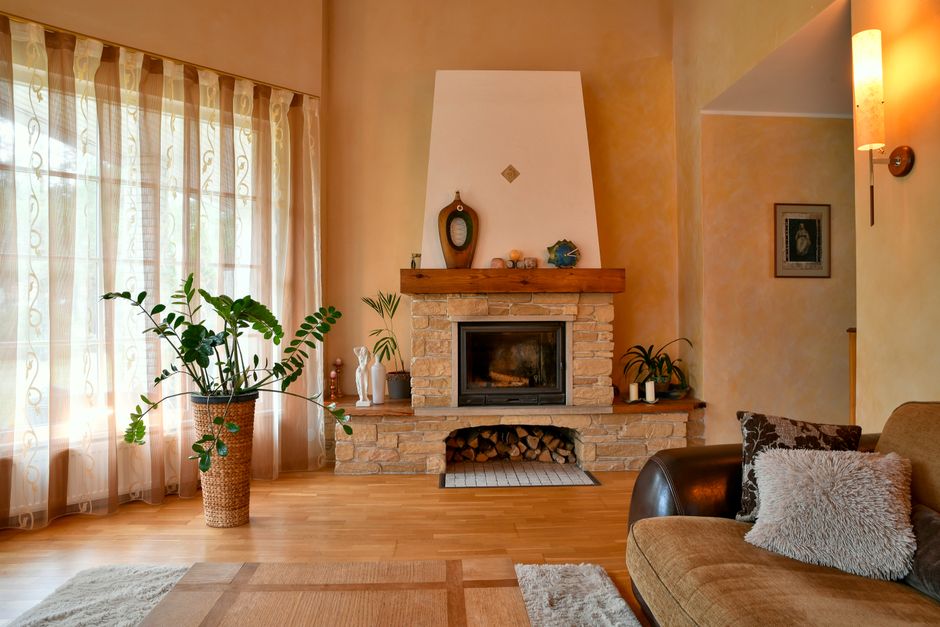
For the first three winters in this cottage, the sitting room looked like a cottage but didn't feel like one. Visitors would say how lovely it was and then we'd all sit there in our jumpers, slightly chilly, with the overhead light washing everything in the wrong sort of beige, and I'd think: this isn't it yet.
The room is the one that matters most in a Cotswolds cottage. Low beams, original inglenook fireplace, stone floor under the rug. It has all the ingredients. What it didn't have for a long time was warmth — the actual felt warmth of a room that wraps around you on a November evening. That's not structural. It's choices.
Here's what I eventually worked out, mostly by trial and expensive error.
The Overhead Light Was the Problem
We had a single central pendant on a ceiling rose, hung low because of the beams. It lit the centre of the room and left the corners cold. That's the worst possible thing in a cottage sitting room. Cottage rooms are meant to glow from the edges, from sconces and lamps, not from the centre. The eye is drawn to the warmth at the periphery, not the brightness in the middle.
I removed the pendant entirely in January two years ago. Just took it down and plugged the ceiling rose. For three weeks we used only the fire and two plug-in sconces flanking it. The room immediately felt more like the cottage it is.
The sconces are brass, plug-in, mounted at about 155 centimetres from the floor on each side of the inglenook. They're from BO-HA's brass sconce range, and the warm 2700K bulb inside them glows against the old plaster in a way that reads as completely period. No drilling into stone, no rewiring. Just a plug and a cord cover painted to match the wall. That's the same approach I used throughout the cottage.
What "Cosy" Actually Requires
The word cosy is overused. Used properly it means: the room responds to you. The light is low enough that your face doesn't feel interrogated. The textiles are heavy enough to absorb sound. There are multiple sources of warmth, not just one radiator. And there is something alive in the room, either a fire, a candle, or a lamp with a warm-white bulb that flickers almost imperceptibly when someone walks past.
That last point matters more than people realise. A 2700K LED bulb has a very slight variation in output that reads at the edge of perception. It's not quite the same as candlelight, but it's not the flat dead certainty of a 4000K bulb either. Get the colour temperature wrong and no amount of linen cushions fixes it.
The Rug Underneath All of It
I made the mistake of trying to work with the stone floor in winter. Stone floors are marvellous in July. In December they are cold and they stay cold. The Persian rug from the bedroom moved into the sitting room two winters ago and hasn't gone back. It's a faded terracotta and navy piece my mother-in-law gave us, about 240 by 170 centimetres, and it covers most of the floor in front of the fire. Instantly: warmer room. The sound changed too. Less echo, more absorption.
I bought a newer rug last year to replace it and the sitting room felt wrong within a week. The new rug was too saturated, too obviously a rug purchase. Back went the inherited one. Some things can't be bought new.
Curtains That Actually Do Something
Cottage windows are small, which means the wall around them is large, which means badly hung curtains look dreadful. I've seen it in every renovation programme: curtains hung inside the window recess, blocking what little light comes in and doing nothing to insulate. Our curtains are hung 15 centimetres above the lintel and extend 25 centimetres either side of the frame. Drawn at dusk, they cover a full metre of wall on each side and actually hold the heat in. Linen lined with blackout. Took me three years to get this right.
The One Thing I'd Take Back
The exposed stone feature wall. We stripped the plaster from one section of wall to expose the original Cotswold stone, which photographs spectacularly. It also radiates cold into the room from October to April. Bare stone is a thermal sponge. I now keep a large woven hanging on part of it from November through March, which helps, but the lesson is: in a working cottage, not a holiday let, exposed stone in a sitting room is a romantic idea with real consequences. If I did it again I'd keep the plaster on the interior walls and save the stone for the exterior, where it belongs.
The sitting room is right now. It took three winters and more money than I'd like to admit, but it's the room we actually live in from November to March rather than hurrying through on our way to somewhere warmer. That was the goal all along.