When people ask what makes a cottage feel like a cottage on a winter evening, the honest answer is almost always the light. Not the furniture or the curtains or the cushions, though those matter. The quality of the light is what actually does it. A well-lit cottage room with nothing but a few decent chairs in it feels more like a place to settle than a showroom full of carefully chosen pieces under the wrong kind of light.
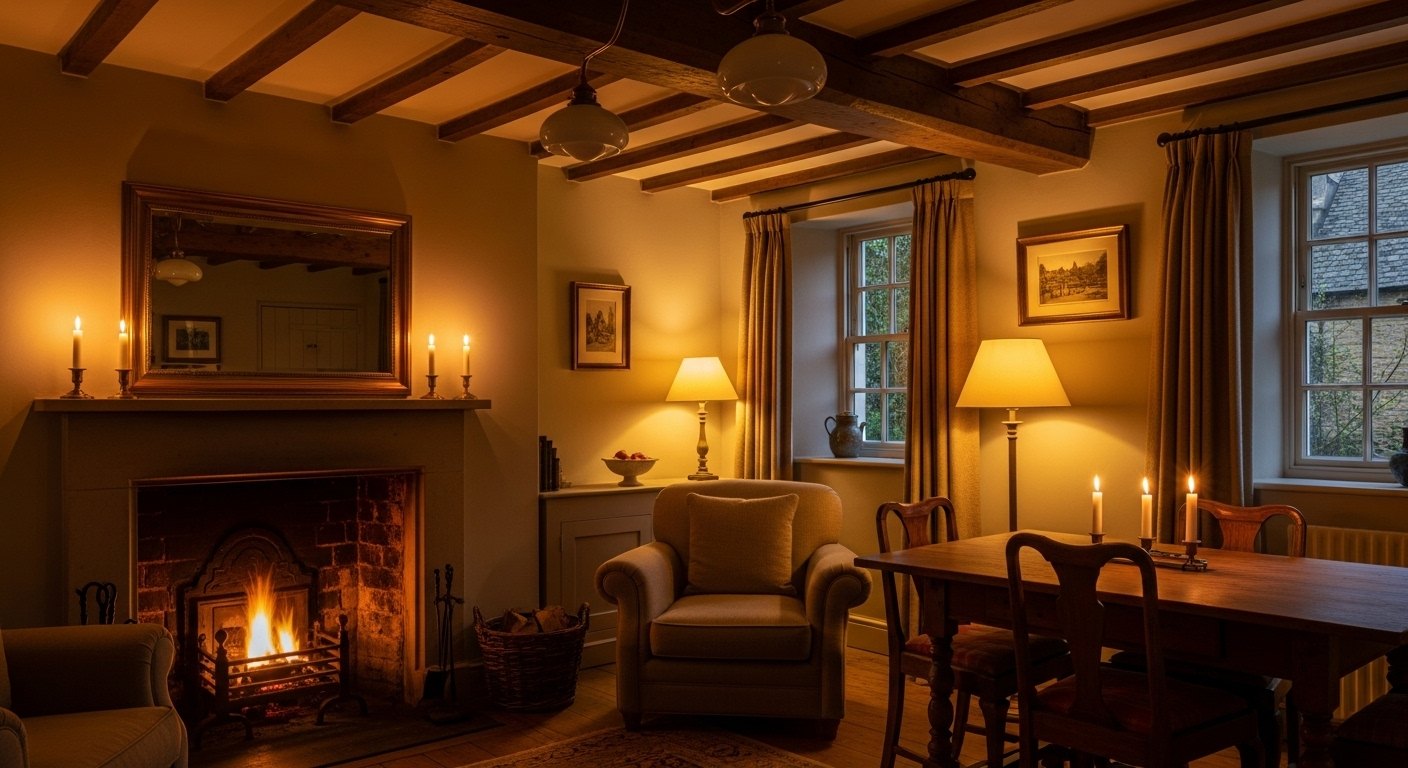
We have a sitting room in the Hartley Cottage that is roughly four metres by four, with a large inglenook at one end, original stone flags on the floor, and low plaster ceilings. It took us eighteen months to get the lighting right. Six sources, six switches, all on dimmers. This is what they are and why each one earns its place.
Layer One: The Fire
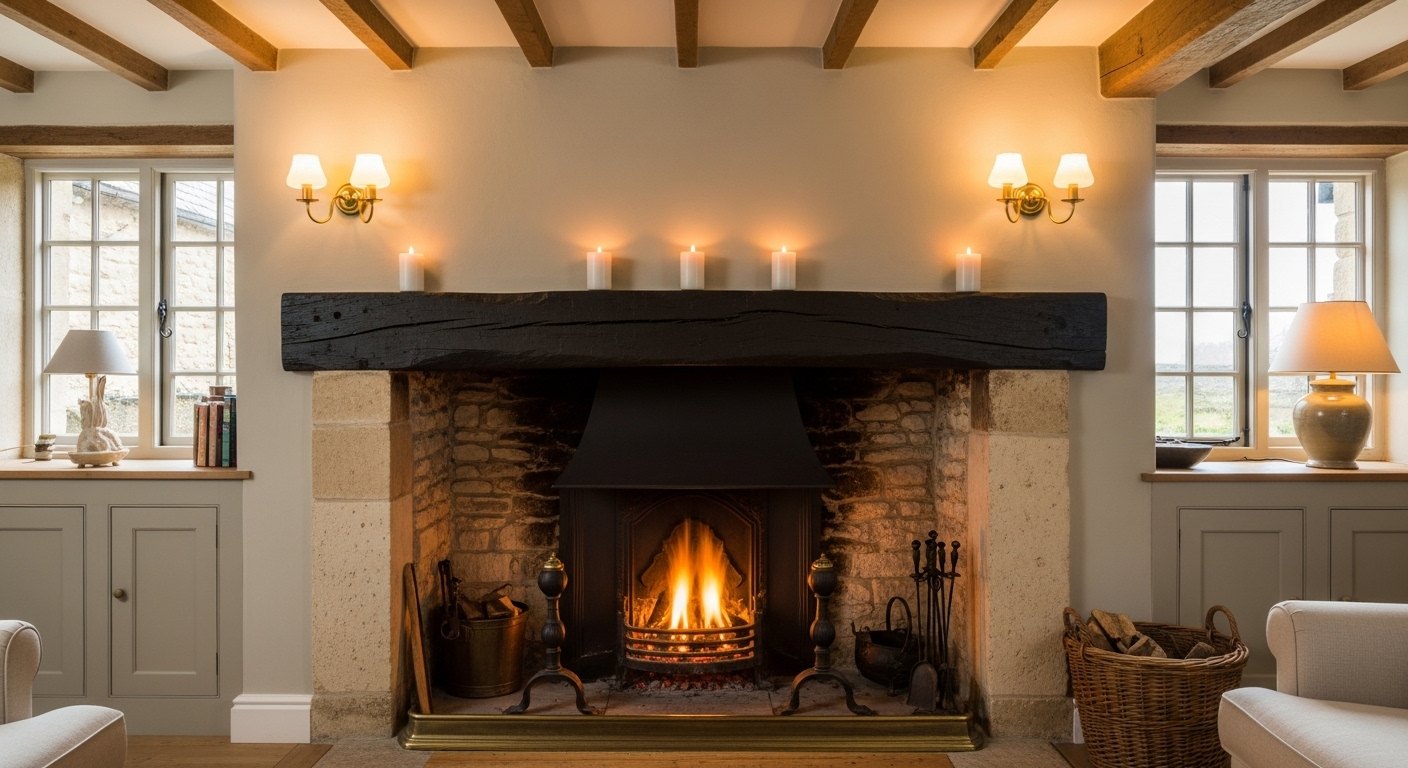
This is not a joke. The fire is the first and most important light source in the room, and every other layer is designed around it. A fire burns at somewhere between 1700K and 2000K, which is extremely warm orange light, dynamic and directional. It lights the hearth side of the room brightly and leaves the far side in relative shadow. That contrast is the entire atmosphere. Your other light sources should reinforce it, not flatten it.
When the fire is lit, all overhead lights go off. No exceptions. An overhead fixture running at the same time as a fire produces two competing light directions and two competing colour temperatures, and the result looks wrong in a way most people can't name but everyone feels. The overhead stays off.
Layer Two: The Flanking Sconces
Two wall sconces on the chimney breast, one either side of the inglenook, at about eye-height when seated. Ours are warm brass with a diffused glass shade that produces soft forward and upward light. On a dimmer. When the fire is burning, they run at about 15 to 20% of full brightness.
What they do at that level is fill in just enough light on the chimney breast wall so the stone and the beam read in the room, rather than disappearing into shadow. They don't light the room, they light the hearth wall. The fire does the rest. Without them the flanking stone goes dark and the hearth starts to look like a black hole in the wall. With them at 15%, the whole chimney breast reads as a unified feature.
These are on their own switch and dimmer, separate from everything else. That separation is important. You want to adjust them independently of any other source in the room.
Layer Three: The Seating Table Lamps
A table lamp beside each of the two main armchairs. The shades are a warm amber linen, which means the light coming out is already tinted toward the warm end before it even hits a 2200K bulb. At full brightness they're reading lamps. At 30% they're companionable. We dim them to about 30-40% when the fire is going.
Height matters here. The base of each lamp sits at roughly the same level as the arm of the chair, which puts the light source at approximately seated eye height. This means the lamp lights the person in the chair from the side rather than from above, which is the most flattering and comfortable direction for reading and conversation both. Floor lamps at standing height don't do the same thing; they're too tall and too bright for a fireplace room.
The table lamps are on a single shared switch so you can bring both up and down together without walking across the room. They're on their own circuit from the sconces so neither interferes with the other.
Layer Four: The Candles
Beeswax. Not paraffin, not soy — beeswax. The colour temperature of a beeswax candle is about 1500K, which is warm even by the standards of firelight. Paraffin candles run cooler and bluer and they show. We keep three on the mantel beam (never more, see the inglenook styling post for why), two on the low table between the chairs, and a single large pillar on the bookshelf at the far side of the room.
The far-side candle is the most important one. It's about four metres from the fire. The fire is the dominant light source and the side of the room the fire is on is naturally brighter. The candle on the far bookshelf brings up the far wall just enough that the room doesn't read as one bright end and one dark end. You don't notice it consciously. You notice that the room feels balanced.
Candles are technically not a wired layer, but they function as a layer in the lighting scheme and they need to be thought about as one. Their position is not arbitrary.
Layer Five: A Floor Lamp for Winter Afternoons
There's a category of winter light we don't talk about enough: the hour between about 3pm and 4pm in December when the sky outside is flat grey, the fire is just starting to build, and the room is at its most in-between. Not dark enough for full evening mode, not bright enough to feel comfortable without supplementary light. This is where an arc or uplighter floor lamp earns its place.
Ours stands in the corner behind one of the armchairs and points upward toward the ceiling. At full brightness it pushes around 800 lumens onto the plaster ceiling, which diffuses it into a soft wash. It's on a dimmer. In full winter-afternoon grey light I run it at 70%. Once the fire properly takes, it goes to 20% or off. It's not a fireplace-evening layer; it's a transition layer, and having it on its own switch means the transition is one click.
Layer Six: No Overhead
This is a layer by subtraction. The overhead fixture in the sitting room is a small flush mount in the centre of the ceiling. It exists for cleaning, for finding things you've dropped, and for the occasional summer afternoon when none of the other layers are needed. When the fire is lit, it is off. That's the rule and it doesn't have exceptions.
The reason is simple: overhead light comes from above, which is not where warm natural light comes from. Firelight, candle light, and lamp light all come from below eye height or at eye height. Overhead light interrupts that character entirely. On the dull grey evenings when I'm tempted to flip it on because the room feels dim, the answer is always to turn the table lamps up slightly rather than to add the overhead. It always looks better.
The Switch Layout
In our sitting room, all six inputs are on two panels near the door:
- Panel A: chimney breast sconces (dimmer), floor lamp (dimmer)
- Panel B: table lamp pair (shared dimmer), overhead (simple switch)
- Candles on their own — which is to say, you light them by hand, which is exactly right
Before the fire, the sequence is: table lamps on at 60%, floor lamp on at 70%, sconces at 50%. Once the fire takes, over about twenty minutes: sconces down to 15%, table lamps down to 35%, floor lamp down to 10% or off. Candles lit by the time the fire is going. The overhead stays off throughout.
It sounds like a lot of steps but it takes about four minutes total. Then you sit down and the room is exactly right.
Shop this post: brass wall sconces for the chimney breast flanks and pendant lighting for other rooms in the cottage. All wired fixtures in a fireplace room should be on dimmers.
The One Thing Most People Get Wrong
They try to make the room bright enough. A cottage sitting room with a fire in it should not be bright. It should be warm. The two are different things. The instinct to add more light when something feels off is almost always wrong in a fireplace room. The thing that feels off is usually the colour temperature or the direction, not the quantity. The fix is to warm up and lower, not to add.
The most flattering and most comfortable fireplace room is one where the fire is the brightest thing in the room. Make that true with your other sources, and the rest arranges itself.