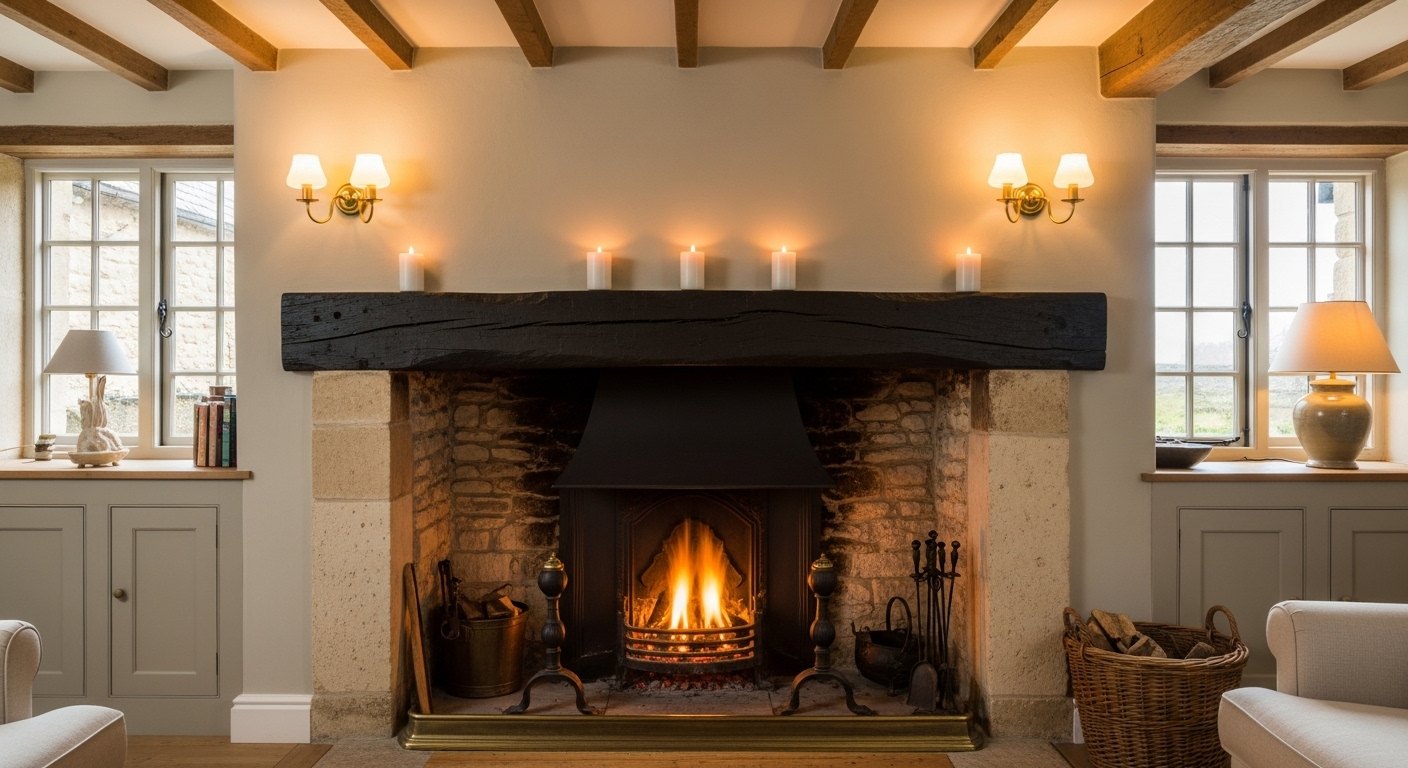
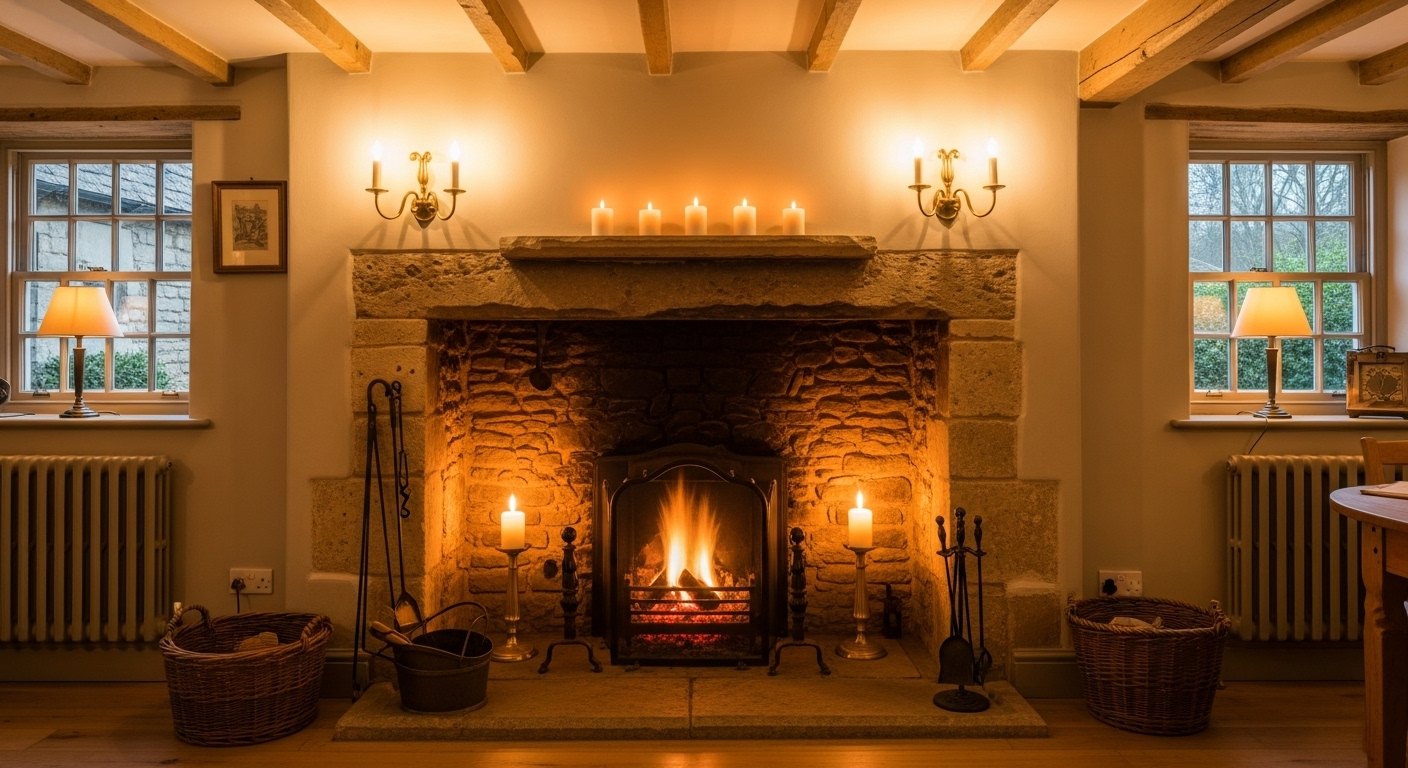
The inglenook was the reason we bought the cottage. A great sooty recess with a blackened oak bressummer beam, wide enough to stand inside, with a deep hearth of original Cotswold stone. On the day we first saw it, there was a fire going. I didn't look at anything else in the house for about twenty minutes.
And then we moved in and I spent the better part of a year getting the styling wrong before I understood the one rule that makes an inglenook look right: restraint is not optional. It is the whole thing.
Inside the Recess
The inside of the recess is not a display shelf. It is a firebox. In winter, the fire is in there, which settles the question. In summer, when the hearth is empty, most people fill the gap with something decorative, and almost everyone puts too much in. I have tried foliage arrangements, candles in a cluster, stacked books, and a large piece of driftwood. Each one looked worse than the last.
What actually works inside an empty inglenook recess: a flat stack of split logs, five or six pieces laid with the end grain facing out, a simple cast iron log basket, and one object. One. I use a piece of white quartz I found walking the Cotswold Way. In October it went in. I've not moved it. The temptation to add things is the enemy of an inglenook.
The fire irons belong inside the recess too, standing to one side. A good set of irons from 1920 or earlier looks right because it is right. A matching set bought new and made to look old usually doesn't. If you find proper old fire irons at a market, buy them. Ours cost eleven pounds and they are the best eleven pounds I've spent in this cottage.
On the Beam
The bressummer beam is not a mantelshelf in the conventional sense. It's a structural timber that's been in the wall for three hundred years. It has enough presence on its own that it doesn't need much help. Three to five objects, with gaps between them, is the rule I've settled on. More than five and it starts to look dressed. The gaps matter as much as the objects.
What sits on ours: a dried sprig of rosehip from the garden, a pair of beeswax pillar candles in plain holders, and one small watercolour propped against the stone. The watercolour cost three pounds at a Stow-on-the-Wold market. It is not a significant painting. But it is old, and it is small, and it looks like it has always been there. That's the standard to aim for.
Seasonal swaps are the only reason to touch the beam. In December the rosehip comes down and a small piece of holly goes up, then back again in January. Everything else stays put.
The Chimney Breast
The chimney breast is the wall above and around the inglenook, and the most common mistake is putting too much on it. Sconces on both sides and a mirror above and a garland and a pair of prints. Pick one thing.
We have a pair of warm brass sconces flanking the chimney breast, one on each side at eye level. That is everything. No art on the chimney breast wall because the inglenook itself is already the art. The lighting around the inglenook is deliberately minimal for exactly this reason: anything that competes with the fire and the stone loses.
If you want a painting above the fireplace, remove the sconces and let the painting be the single chimney breast feature. Then put the sconces somewhere else in the room. Both things are good. Both at once on a small cottage chimney breast is too much.
What Not to Put in an Inglenook
String lights on the bressummer beam. I see this everywhere and it looks like a Christmas market stall rather than a three-hundred-year-old hearth. The beam doesn't need help looking magical; it does that on its own.
Mirrored objects inside the recess reflect the fire in odd ways and the reflections distract from the fire itself. The recess should be dark stone and warm light, not shimmer.
Matching sets of anything on the beam. Matching tends to look purchased rather than accumulated, and accumulated is the only register that works in an old cottage.
More than one focal point. The fire is the focal point. Everything else is support.
The Seating
Our inglenook is wide enough to put a small chair inside it, which is where the cat sits. We don't, because the draw of the chimney pulls heat out of the room and sitting inside the recess when the fire is going is less comfortable than sitting two feet back facing it. But the chair inside looks right even unoccupied.
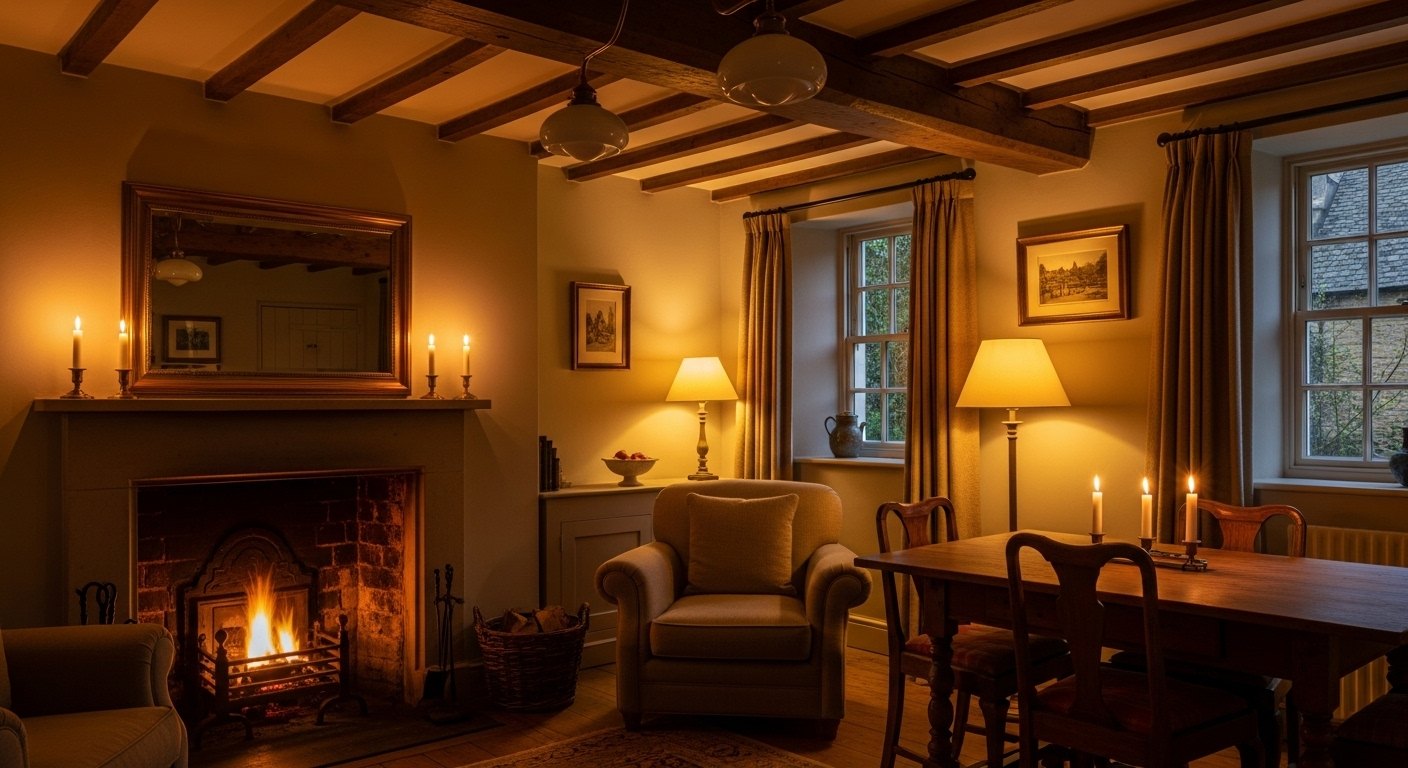
The main seating is arranged to face the hearth. Two armchairs at about eight feet out, angled slightly toward each other so you can face both the fire and the person you're talking to. This is the correct geometry for an inglenook room, and it took us three rearrangements to arrive at it.
Shop this post: brass wall sconces for the chimney breast. We run ours dimmed to about 20% when the fire is lit so the flames stay brightest.
The One Thing I'd Do Differently
I'd have left the recess completely empty for a full month before putting anything in it. Moving in and immediately styling it meant I went through five arrangements before landing on the right one. The right one was obvious once I stopped trying. One log stack, one stone, one pair of fire irons. An inglenook that looks like it hasn't been thought about too hard took me longer to achieve than anything else in the cottage.